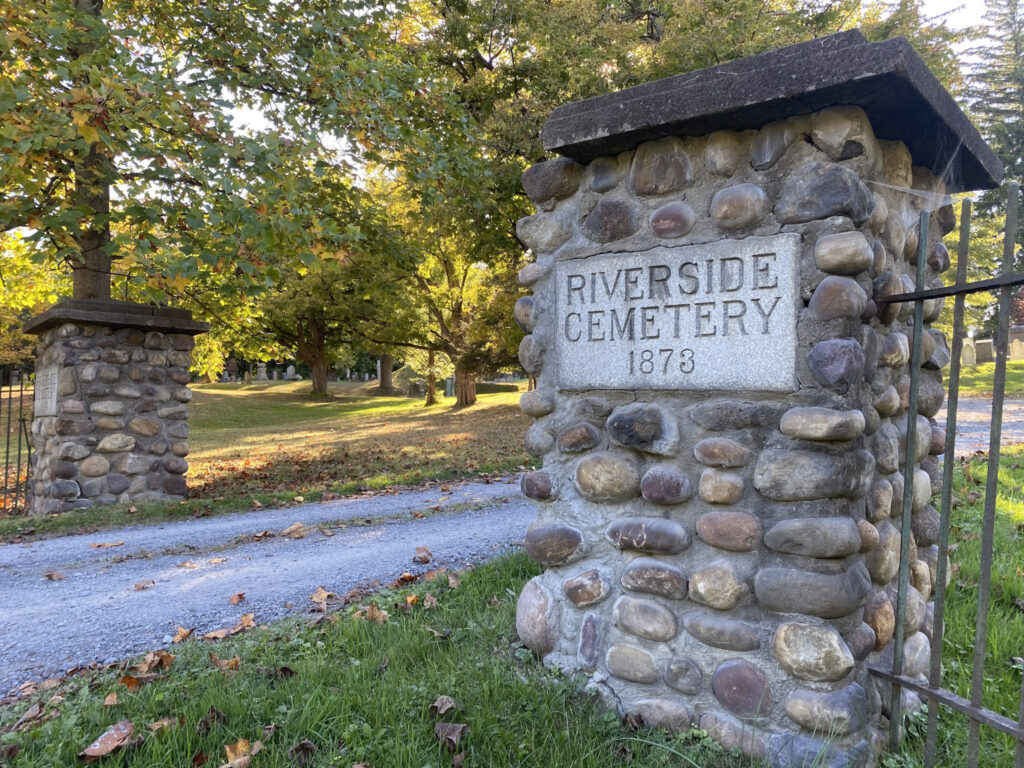

Never a large cemetery, the Village (Mansion Street) burying ground originally sponsored by the Dutch Reformed Church in 1826 was running out of space. Even those families fortunate enough to have inherited plots were faced with the same problem. The need for a new cemetery was obvious to all as the Civil War receded. Thus it was that on December 8, 1872, a group of responsible Coxsackie citizens assembled at the office of Jacob C. Van Dyck at which gathering local jeweler Lucius Botsford would fill the chair.
Of interest is the fact that no women were invited, probably because of the Victorian morality of the times. Known to be in attendance besides Jacob C. Van Dyck were Martin G. Van Slyke, William K. Reed, Simpson S. Bell, Sidney A. Dwight, Sylvester W. Briggs, George H. Bomus, E.D. Fancher, William J. Leigh and John L.B. Silvester. Messrs Botsford, Van Slyke, Reed, Bell, Dwight, Briggs, Bomus, Fancher and Leigh would be elected trustees.
At the second session officers were elected for this new Riverside Cemetery Association: L.F. Botsford would assume the presidency while M. G. Van Slyke would serve as vice president. Financial matters would be the responsibility of treasurer S.A. Dwight while correspondence, minutes, etc. were duties assigned to secretary W.K. Reed, local undertaker.
Designated a “committee of three” “to secure and purchase suitable ground” were Alexander Reed, Lucius F. Botsford and William Kempton Reed. Their selection was a plot approximately 21-22 acres “more or less” owned by Miss Alida Van Slyke.
Alida Van Slyke was the older sister of Martin G. Van Slyke, also on the cemetery committee. They were the children of Andrew T. Van Slyke and wife Catharine.
Andrew T. Van Slyke was a prosperous farmer with substantial acreage near the Coxsackie-New Baltimore town lines. He employed Eliza Egbertsen, Andrew Sharp, and Mary C. Rey–all according to the census of 1855.
According to the 1880 Directory of Greene County Martin G. Van Slyke lived in the township of Coxsackie where he owned 135 acres of lands. He was classified as a farmer. Alida Van Slyke apparently never married but resided over the town line in New Baltimore but still owned 85 acres in the township of Coxsackie.
The Coxsackie Union under date of July 5, 1873, would be high in praise for the site selected: “It is beautifully located, a short distance above the Upper Landing, commanding a fine view of the river and is appropriately called ‘Riverside Cemetery.’ There will be entrances to it from the road leading from the river road and also the road leading north from the Upper Village. It is the design of the trustees to lay out and beautify it, that it shall be an ornament to the town and unsurpassed in attractiveness by any of the cemeteries about us.” Undoubtedly in those days the fields to the east were not overgrown with trees and brush, allowing for an unimpeded viewshed of the river. Editor Franklin made no mention of the superb view westerly to the northern Catskills.
Credit for the physical layout and mapping of the purchase acreage goes to Burton G. Thomas. Just how the capital was raised is uncertain. The local newspaper would report: “As soon as lots are ready for sale notices will be given in the News.” A surviving indenture for Section Six, Lot Five, sold to John Kennedy calls for a payment of seventy-five dollars. By that year, of 1881 F.S. Greene would sign as president and S.H. Dwight as treasurer. The deed form would be illustrated with an engraving of burial procession under way, leading from the distant village with its church steeple to the graveyard. The horse-drawn funeral hearse and mourner’s carriage were followed with what appears to be a long line of attendees.
Chapter 296, NYS Laws of 1873, does not give any indication that Riverside Cemetery Association was incorporated in that year as it details New Baltimore’s Chestnut Lawn.
Riverside Cemetery would soon receive the remains of those individuals who had been interred in ground which would later be for the site of the Upper Village’s Potash Works. It was Charles Sharp who inserted an advertisement in the Coxsackie newspaper giving public notice that their buried relatives had to be removed to a lot he had purchased in Riverside. The construction in this century of the New York State Thruway dictated the removal of many bodies from the Hotaling cemetery to Riverside. The contractors soon found out that Hotaling burial grounds had contained far more remains that the stones would have led them to believe.
The Riverside Cemetery Association has served the township of Coxsackie well. Increased maintenance costs have required a need for appeals for additional contributions to augment any endowment funds. The public has responded generously.